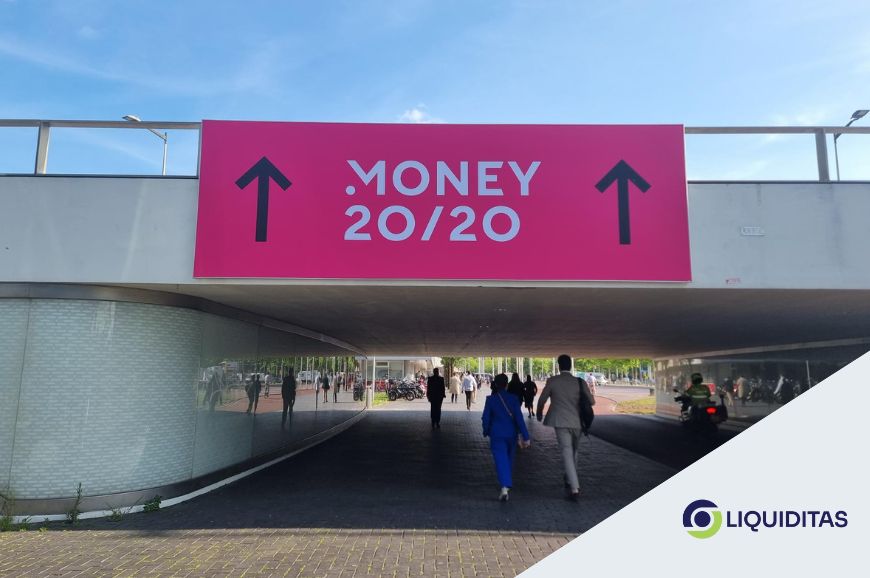
What We’re Building Next – The Real Lessons from Money20/20
I. Introduction: Cutting Through the Noise
Money20/20 was loud. The kind of loud that fills your calendar, your inbox, and your head with overlapping narratives about the next big thing. But somewhere in between the hype, there were sharp questions being asked, the kind that matter.
This year brought fewer unveilings and more pressure-testing. Across stages and side meetings, the conversation kept returning to the same friction points: liquidity, alignment, access, and the actual speed of adoption. That’s why we showed up – to track where momentum is building and where resistance still lives.
II. The Tech is Loud. Execution is Louder
Embedded. Programmable. Autonomous. Every corner of the event had a fresh acronym or buzzword attached to finance.
But underneath the surface, there was a quiet shift happening – less about invention, more about integration. Not what’s possible, but what actually works.
Agent-based AI drew attention. Not because it’s novel, but because people are trying to figure out how to fit it into broken workflows. Stablecoins and embedded treasury platforms sparked strong opinions, but the common thread was practicality. The room had moved on from debating “if” and started asking “how soon.”
The companies that stood out weren’t shouting. They were connecting dots between tools, teams, and outcomes.

III. Finally, SMEs are Front and Center
One theme refused to stay on the sidelines: SME lending.
It came up in panel rooms, keynotes, hallway chats – everyone had a take, but more importantly, there was action behind the words. Banks and fintechs seem to be circling the same challenge: how to build scalable, reliable credit solutions for small and mid-sized businesses without flattening them into risk categories that don’t reflect their reality.
The numbers are obvious – SMEs bring in over 20% of bank revenue and hold more deposits than retail customers. But the systems serving them haven’t evolved fast enough. Traditional underwriting still stumbles over their variability. Embedded credit, factoring, and data-driven lending are pushing through, but the delivery models are inconsistent.
In one panel, SG Factoring joined forces with a fintech lender and an accounting platform to show how capital can move through shared infrastructure. Each player brought a different strength—regulatory grounding, digital access, and operational insight. Together, they built a financing path that fits how SMEs actually work.
This model speaks directly to the direction we’re moving in. Banks don’t need to go it alone. And front-end platforms serving SMEs – whether accounting, ERP, or finance apps – can unlock value by plugging into embedded lending infrastructure that works from day one.
The market is still cautious. But the ground is moving. The high-risk label is slowly turning into high-potential.
IV. Connectivity: Cracks in the Adoption Curve
Integration dominated the conversation — but not in the way the industry expected. The appetite is not for new payment rails; it is for invoices, approvals and programme status to move between systems the buyer already runs, without a rebuild.
It’s no longer just a European regulation play or a catchy conference keyword. It’s entering the zone where expectations run faster than delivery. While many talked about real-time payments as the future, the infrastructure gaps and regional fragmentation kept surfacing.
The promise is clear. Data portability, instant settlements, account-to-account payments—they’re no longer fringe features. But rollouts remain uneven. Some markets are charging ahead with strong use cases. Others are stalled in UX friction, trust gaps, and lack of cohesive standards.
The idea of “pay by bank” came up with fresh data. 80% of e-commerce platforms have it on their roadmap. 90% expect to act on it within a year. That momentum signals a shift. But until protections, user experience, and consistency catch up, it will stay on the edge of mainstream.
The strongest message came from the panels that pushed for co-opetition—shared infrastructure, aligned incentives, and cross-industry scale. That’s what it will take to make real-time funding a global standard.
V. Liquidity Isn’t a Side Concern – It’s a Strategy
Liquidity came up in nearly every conversation that mattered—whether it was framed as treasury optimization, embedded payments, or freeing up working capital.
It’s no longer confined to CFO dashboards or back-office planning. It’s becoming a competitive edge, a product feature, and a leadership issue.
Embedded B2B payments are growing at a pace that demands attention—20 to 30% annually. Real-time treasury data is shifting how finance teams plan, act, and even structure their teams. Companies aren’t just looking for better forecasting—they’re actively hunting for control.
Some of the most compelling examples came from those blending AI into financial operations. Not for the sake of trend-chasing, but to remove latency from cash decisions. Whether it was invoice processing, bank reconciliation, or dynamic supplier payouts, the message was the same: velocity matters.
What’s emerging is a new level of liquidity visibility – smarter, faster, and embedded deep into workflows. This is the layer Liquiditas was built to work in. Not to sit on top of outdated systems, but to make liquidity flow where it’s needed, when it’s needed.
VI. Human Alignment Is Still the Hardest Part
You can have the best product in the market, but if the people, the processes, and the timing aren’t lined up, it stalls.
That was a recurring thread in back-to-back sessions on partnerships, fundraising, and internal readiness. Whether the topic was real-time payments or taking a fintech public, the same issue kept coming up: alignment.
Founders spoke about the psychology behind investment pitches. Growth teams shared how friction hides in handovers between marketing, sales, and tech. Even fraud prevention panels came back to one thing – coordinated action across players, not more standalone tools.
AI came up constantly, but the interesting part wasn’t the tech—it was how teams are embedding it inside finance functions without losing clarity or control. One neobank cut customer support wait times from 36 hours to under a minute, not by replacing people, but by training systems that actually fit the way their teams worked.
The standout operators weren’t the loudest. They were the ones building companies that move together, top to bottom, front to back.
VII. Final Thoughts: Who Will Lead from Here?
Money20/20 had no shortage of sharp ideas, strong opinions, and ambitious roadmaps. But what stood out were the companies that showed restraint. The ones that didn’t rush to demo something new just for the optics, but focused on building what people actually need.
This year marked a shift. Flashy alone doesn’t land. Teams are being judged on their ability to execute, adapt, and collaborate at speed. There’s less patience for drawn-out pilots or vague strategies.
At Liquiditas, that message came through loud and clear. We left Amsterdam with clearer signals, sharper opportunities, and a calendar full of follow-ups from the dozens of partner meetings we took across the three days.
The work ahead is complex. But the direction is clearer than ever.

As the Chief Revenue Officer at Hut4 Capital, a global investment group with a diversified portfolio across various industries, I play a pivotal role in driving revenue growth and spearheading strategic investments. Hut4 Capital is distinguished by its operation and investment in key sectors through four main verticals: Software Products (Synami), FinTech (Liquiditas), Digital Media (Clip Media), and Real Estate (Praedium). My role extends beyond the overarching strategy at Hut4, as I actively lead and influence revenue strategies across these distinct yet interconnected verticals.