
Supply Chain Finance in Spain: A €3.5 Billion Market Growing to €12 Billion by 2033
Spain’s supply chain finance (SCF) market is expanding. Small and medium enterprises (SMEs) need working capital, banks are tightening lending, and trade finance is moving online. Today, Spanish SCF represents a few billion euros in outstanding volume. Market reports suggest this will reach roughly €12 billion by 2033. Globally, fee-based SCF estimates are expected to grow from $6-8 billion in 2024 to $15-20 billion by 2033. The total volume of financed trade runs into trillions of dollars.
For Spanish CFOs and investors, SCF is becoming a standard funding option and a large, data-backed asset class.
New European payment rules, persistent SME funding challenges, and digital platforms mean companies that adopt SCF now can improve their funding terms and supplier relationships.
What counts as SCF?
Research firms define SCF as digital programs that provide short-term, transaction-level financing to suppliers. These programs use approved invoices and rely on a large buyer’s credit quality. They include reverse factoring, dynamic discounting, and receivables purchases, usually run through platforms connected to the buyer’s ERP.
The industry measures this in two ways:
- Platform revenues from fees, which total several billion dollars globally.
- Financed volumes, or funds in use. The 2025 World Supply Chain Finance Report tracked $2.6 trillion in total global volume, with over $1 trillion in active funds.
Spanish CFOs should look at both. Platform fees show the maturity of the software, while financed volume shows how much cash is moving to suppliers.
Spain’s place in the global market
Europe accounts for about 26% of global funds in use. Spain is not the largest European market, but it has a high concentration of SMEs, a history of late payments, and strong export sectors like automotive, food processing, and chemicals.
Three main trends drive SCF adoption in Spain:
- Spanish corporations want better ways to manage working capital.
- Regulators want to expand non-bank financing for SMEs, such as securitization and asset-backed finance.
- SMEs are adopting digital tools, making it easier to connect to financial platforms.
Spain Market size and growth trajectory
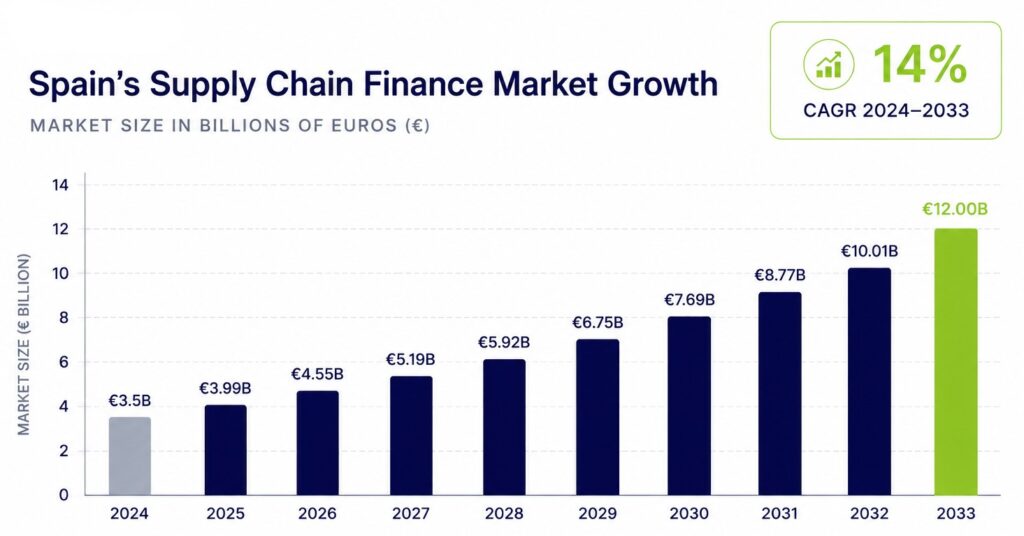
Few public reports detail Spain’s exact SCF market size. However, industry notes suggest the market is worth a few billion euros today and will triple by the early 2030s. A 2026 Spanish market outlook estimate put the 2024 market at $3.5 billion and projected it to reach $12 billion by 2033, representing a 14% annual growth rate.
This aligns with European trends. Trade finance reports project that the European SCF segment will grow by 12% annually from 2025 to 2033, faster than other trade finance products. Spain will likely match or exceed this rate because of its SME structure and late-payment challenges.
Global benchmarks
Global reports confirm that SCF is growing:
- One study estimates the global market will grow from $13.4 billion in 2025 to $14.6 billion in 2026, with an 8.4% annual growth rate through 2035.
- Another projects growth from $7 billion in 2024 to $13.8 billion by 2032, an 8.8% annual rate.
- A third report projects the market will grow from $55 billion in 2024 to $90 billion by 2033, using a broader definition of fee revenue.
Meanwhile, the 2026 World Supply Chain Finance Report shows that actual financed volume reached $2.6 trillion in 2025, a 7.5% increase from 2024. Active funds in use exceeded $1 trillion. Europe represented $677 billion of this total.
Spain’s projected growth fits within this global trend. High late-payment rates and digital adoption make this expansion realistic.
Structural drivers in Spain
Persistent SME financing gaps
The OECD 2026 SME Financing Scoreboard shows that SMEs face high borrowing costs, tighter bank lending standards, and a drop in long-term loans. New lending to SMEs remains below 2022 levels, and banks are offering shorter, more conservative term loans.
Non-bank lenders are filling some of this gap with asset-backed options like factoring, leasing, and invoice financing. The Bank of Spain reports that bank loans remain the main funding source for small companies, but bank lending has declined relative to gross value added since the financial crisis. Many micro-businesses now rely entirely on their own cash flow.
This environment makes SCF highly practical. It provides short-term cash based on the buyer’s credit score, meaning the supplier does not need to take on debt or pledge collateral.
Late payments and new regulations
Spain has a history of late payments. Industry surveys show that many large companies exceed the legal 60-day limit for commercial invoices. In response, Spain established a State Observatory of Private Late Payments in March 2026 to track payment habits and enforce deadlines.
The European Commission has also proposed capping all commercial payment terms at 30 days, down from 60. This change will force companies that rely on long payment terms to find new ways to manage cash. SCF helps buyers keep their cash working while paying suppliers within the new legal limits.
Digital tools in Spanish supply chains
A European Investment Bank study shows that Spanish SMEs are adopting digital tools like ERP systems and electronic invoicing. This digital shift is essential for SCF, which requires automated data sharing, electronic invoices, and fast approvals.
Spanish companies are using digital platforms more frequently to manage supply chain finance. As more businesses digitize their logistics and procurement, the cost of connecting to these platforms drops, making it easier for smaller suppliers to participate.
Dominant SCF products
The SCF market relies on three main options:
- Reverse factoring: The buyer’s bank or platform pays the supplier early at a discount, using the buyer’s credit rating.
- Dynamic discounting: The buyer uses its own cash to pay suppliers early for a discount.
- Receivables purchases: The supplier sells approved invoices directly to a funder.
In Europe, SCF is growing faster than traditional trade finance tools like letters of credit. In Spain, growth will likely come from programs set up by large domestic and multinational corporations with extensive supplier networks.
Sector adoption in Spain
Spain’s supply chain and trade data suggest SCF will grow fastest in these sectors:
- Automotive manufacturing, where Spanish plants connect directly to European supply networks.
- Food and agriculture, where long production cycles require extra working capital.
- Construction and infrastructure, which deals with long subcontractor chains and payment delays.
- Retail, where large retail brands buy from many small suppliers.
These sectors already rely heavily on factoring and trade credit, making them prime candidates for digital finance platforms.
Competitive and platform landscape
Banks and specialist platforms
Banks handle about 89% of global SCF transactions. However, fintech companies and specialized platforms are growing by offering cloud-based systems that connect to multiple funders and ERPs.
In Spain, this leaves companies with three main choices:
- Proprietary programs run by large retail banks.
- Platforms that pool funds from multiple banks and institutional investors.
- Technology providers that sell software directly to banks and corporations.
For a CFO, the choice is between a single-bank program, which might be cheaper but limited, and a multi-funder platform that is easier to scale.
Deep-tier and ESG-linked finance
Two new models are gaining traction in Europe:
- Deep-tier financing: This extends credit past first-tier suppliers to reach smaller subcontractors further down the chain.
- ESG-linked programs: These offer lower financing rates to suppliers that meet environmental or social standards.
Spanish companies are subject to the EU Corporate Sustainability Reporting Directive (CSRD). Using an ESG-linked SCF program helps them track supply chain sustainability while providing liquidity to suppliers.
Why SCF belongs in a Spanish CFO’s toolkit
Spanish CFOs should consider SCF for several reasons:
- Market growth: Spain’s SCF market is expected to grow from $3.5 billion in 2024 to $12 billion by 2033. Early adopters can secure better financing terms and strengthen their position with suppliers.
- Regulatory changes: The State Observatory of Private Late Payments and proposed EU rules make payment delays a legal and reputational risk. SCF allows buyers to pay suppliers faster without using up their own cash.
- Funding options: As bank loans for small companies decline, businesses need non-bank alternatives. SCF provides cash without relying on overdrafts or credit lines.
- Supplier stability: Faster payments keep suppliers in business during economic downturns, and ESG-linked options support sustainability goals.
- Better data: Digital platforms track supplier performance and payment habits, giving treasurers useful data for cash forecasting.
Investor perspective
Investors can access SCF through banks, securitizations, or direct platform investments. These assets are short term, self-liquidating, and offer reliable returns when backed by creditworthy buyers.
Spain’s projected market growth to $12 billion will create a larger supply of these assets. As regulators encourage securitization for SME trade receivables, more institutional capital can enter the Spanish market.
Regulatory and audit scrutiny
Regulators and auditors monitor SCF programs to ensure companies do not use them to hide debt. International accounting bodies require clear disclosure of payment terms and financed amounts.
Spanish companies must structure their programs transparently and disclose them properly. Programs designed to support supplier liquidity rather than delay buyer payments face fewer audit concerns.
Setup and adoption hurdles
SCF programs require coordination among procurement, IT, and finance teams. Small suppliers often lack the resources to connect their accounting systems to new platforms. Some may also avoid these programs if they associate them with aggressive factoring.
Modern software simplifies onboarding, but buyers still need to educate suppliers to ensure high participation.
Economic conditions
High interest rates can make SCF less attractive if financing costs rise too close to traditional borrowing rates. However, economic downturns also increase the demand for flexible cash options. The final impact will depend on interest rate trends and bank lending policies.
Strategic takeaways
- CFOs should view SCF as a long-term funding source, not a temporary fix. Spain’s projected market expansion to $12 billion shows that these programs are becoming standard corporate tools.
- Digital integration is essential. CFOs must invest in electronic invoicing and ERP connections to run efficient programs.
- Use SCF to meet compliance and ESG goals. Offering better rates to sustainable suppliers helps companies meet environmental standards while complying with new payment laws.
- Investors must select programs carefully. Focus on assets backed by stable buyers in sectors like automotive and retail, using platforms that offer clear reporting.
Spain’s SCF market combines growth, regulatory backing, and digital readiness. Financial leaders who adopt these programs early can secure reliable funding and improve supplier stability.

As the Chief Revenue Officer at Hut4 Capital, a global investment group with a diversified portfolio across various industries, I play a pivotal role in driving revenue growth and spearheading strategic investments. Hut4 Capital is distinguished by its operation and investment in key sectors through four main verticals: Software Products (Synami), FinTech (Liquiditas), Digital Media (Clip Media), and Real Estate (Praedium). My role extends beyond the overarching strategy at Hut4, as I actively lead and influence revenue strategies across these distinct yet interconnected verticals.